

New AI Tools in 2026: The Biggest Launches Changing How We Work
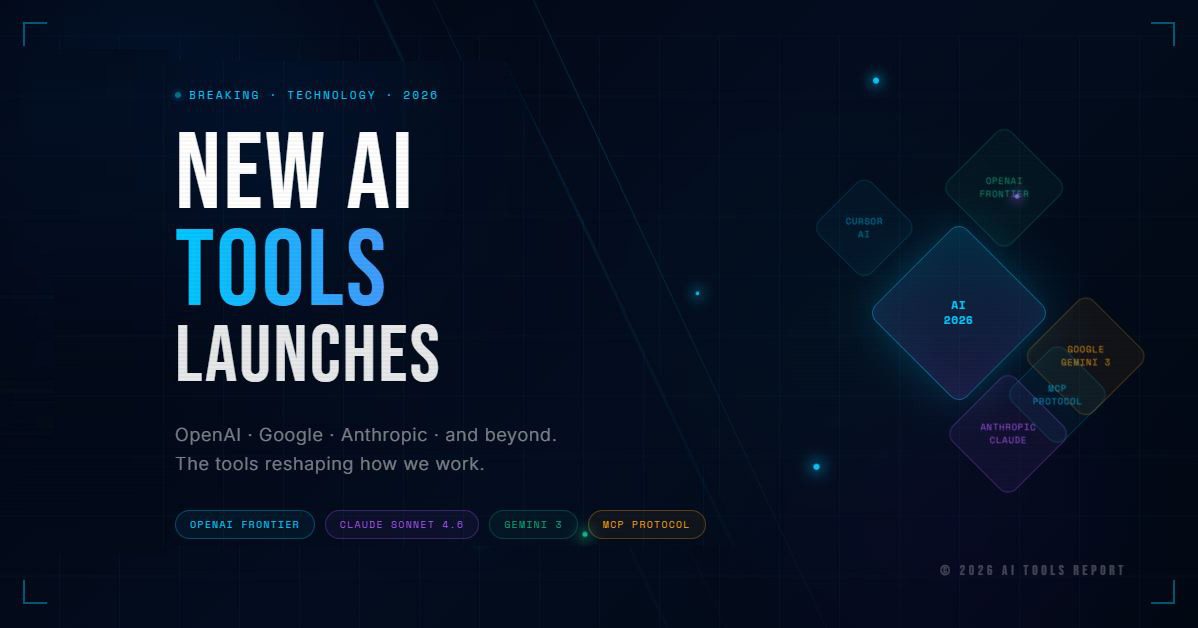
Artificial intelligence is no longer a novelty — it’s infrastructure. In just the first months of 2026, the world’s biggest tech companies have shipped a wave of new AI tools that are fundamentally changing how businesses operate, how software gets built, and how everyday users interact with technology. From intelligent coding assistants to agentic enterprise platforms, this roundup covers the most significant AI tool launches you need to know about right now.
Quick Summary (TL;DR)
- OpenAI launched Frontier, an enterprise agent management platform.
- Google released Gemini 3 as the backbone of Search and Workspace.
- Anthropic’s Claude Sonnet 4.6 now outperforms premium models on many office tasks.
- AI coding tools like Cursor now write meaningful portions of production code.
- Anthropic’s MCP protocol is becoming the new universal standard for AI agents.

1. OpenAI Frontier: Enterprise AI Agent Management
OpenAI made its boldest enterprise move yet in early 2026 with the launch of OpenAI Frontier — an end-to-end platform designed for businesses to build, deploy, and manage AI agents at scale. Unlike earlier chatbot-focused products, Frontier treats AI agents the way companies manage human employees: with onboarding workflows, performance feedback loops, and governance controls.
What makes Frontier stand out:
- Open platform — manage agents built outside of OpenAI too
- Agents can connect to external data sources and execute multi-step tasks autonomously
- Enterprise customers include HP, Oracle, State Farm, and Uber
- Follows a limited rollout, with broader access planned in coming months
Enterprise adoption has been OpenAI’s primary focus for 2026, and Frontier signals that the company sees agent management as foundational infrastructure — not a feature, but a category unto itself.
2. Google Gemini 3: AI Woven Into Everything
Google kicked off 2026 by making Gemini 3 the default engine powering Search AI Overviews globally, Chrome’s new autonomous browsing features, Gmail, Google Docs, and Slides. The model is built for multimodal tasks — handling video, spatial reasoning, and massive context windows natively.
Key Google AI launches in early 2026:
- Chrome’s ‘auto browse’ — handles multi-step tasks like booking travel on your behalf
- Gmail’s AI Inbox — filters, summarizes, and surfaces what matters most
- Google Workspace Studio — design and deploy AI agents directly in Google apps
- Universal Commerce Protocol (UCP) — a shared language enabling AI shopping agents
- Veo 3.1 — updated video generation with reference image support for mobile-ready outputs
Google’s bet is clear: integration wins. By embedding Gemini 3 across the apps billions of people already use, Google doesn’t need to convince users to adopt AI — they’re already inside it.

3. Anthropic Claude Sonnet 4.6: Premium Performance at Lower Cost
Anthropic launched Claude Sonnet 4.6 as its new default model in early 2026, and the results have been striking. The model improves on coding performance, long-context reasoning, and computer-use capabilities — and in some benchmarks outperforms even Anthropic’s own premium Opus 4.6 model on real-world office tasks.
This release is part of Anthropic’s broader pattern of pushing advanced capabilities to mainstream tiers. Enterprise adoption has accelerated dramatically, with $1M+ annual customers growing from roughly a dozen to over 500 in two years. Separately, Anthropic’s Claude Cowork platform launched new integrations with Slack, Intuit, Docusign, LegalZoom, FactSet, and Gmail — enabling businesses to deploy customizable AI agents across financial analysis, engineering, and HR workflows.
4. AI Coding Tools: From Autocomplete to Collaborative Partner
The developer toolkit in 2026 has undergone a fundamental shift. AI coding assistants have evolved beyond simple autocomplete into collaborative tools that understand entire codebases, reason about architectural decisions, and safely implement changes across multiple files simultaneously.
Notable tools leading the pack:
- Cursor — VS Code rebuilt with AI at its core; excels at multi-file edits and architectural refactoring
- GitHub Copilot — now deeply integrated into enterprise workflows
- Lovable & Replit — enabling non-developers to build apps with plain English prompts
According to the heads of Microsoft and Google, AI now writes up to 30% of Microsoft’s code and over 25% of Google’s. The trend is real — and accelerating fast.
5. MCP: The ‘USB-C for AI’ Goes Universal
One of the most significant under-the-radar developments of early 2026 is the rapid adoption of Anthropic’s Model Context Protocol (MCP). Often described as the ‘USB-C for AI,’ MCP is a standard that lets AI agents connect to external tools — databases, APIs, search engines, and enterprise apps — using a common language.
OpenAI and Microsoft have publicly embraced MCP. Anthropic donated the protocol to the Linux Foundation’s new Agentic AI Foundation. Google has begun building its own managed MCP servers. The result: 2026 is shaping up to be the year agentic workflows finally move from impressive demos to day-to-day business operations.
At a Glance: 2026’s Biggest AI Tool Launches
| Tool | Company | Key Use Case |
| OpenAI Frontier | OpenAI | Enterprise agent management & deployment |
| Gemini 3 | Universal AI layer across Search, Chrome, Gmail, Workspace | |
| Claude Sonnet 4.6 | Anthropic | Coding, long-context reasoning, computer use |
| Claude Cowork | Anthropic | Enterprise integrations: Slack, Docusign, FactSet, Gmail |
| Cursor | Anysphere | AI-native code editor; multi-file edits & refactoring |
| MCP Protocol | Anthropic / Linux Foundation | Universal standard for AI agent tool connectivity |
| Veo 3.1 | AI video generation from reference images | |
| ChatGPT Pulse | OpenAI | Personalized proactive daily AI briefings |
What This Means for Businesses and Professionals
The AI landscape has matured from experimental novelty to essential business infrastructure. What was once a question of ‘should we use AI?’ has become ‘how do we orchestrate AI effectively?’ Here’s the bottom line for different audiences:
- For business leaders: Agent management platforms like OpenAI Frontier and Anthropic Cowork are moving AI from a pilot project to core workflow infrastructure.
- For developers: Tools like Cursor and GitHub Copilot are not optional productivity boosts anymore — they’re competitive necessities.
- For marketers and creators: Google’s Veo, Gemini in Gmail, and WordPress’s AI assistant lower the barrier to high-volume, high-quality content production.
- For everyone: The MCP standard means AI tools will increasingly talk to each other seamlessly — unlocking an interconnected layer of automation that didn’t exist a year ago.
Final Thoughts
2026 is the year the AI arms race stopped being about raw capabilities and started being about real-world integration. The new AI tools launching right now aren’t just smarter — they’re more connected, more autonomous, and more embedded into the software you already use every day. Whether you’re an enterprise executive, a solo developer, or a curious professional, the question is no longer whether AI will change your work. It already has.